Silicone O-Rings
Custom silicone O-rings manufactured in Worthing, West Sussex — any ring diameter, cut from extruded silicone cord and joined into a seamless seal. No moulds, no tooling cost, no maximum size. From small instrument seals to large silicone O-rings several metres across, in food-grade, high-temperature and sponge silicone.


Any Size O-Ring, Without the Tooling Bill
Every silicone O-ring we make starts life as extruded cord from our own lines. We cut the cord to a precise length, then hot-vulcanise the ends into a continuous ring — so the diameter you need is simply the length we cut. That's why we can make a 40mm ring or a 4-metre ring with equal ease, in any of our silicone grades.
- Cord Ø1mm–50mm — dies already exist for standard sizes
- No tooling charges — unlike moulded O-rings
- Any colour — RAL & Pantone matching available
- Low minimums — from the equivalent of 10 metres of cord
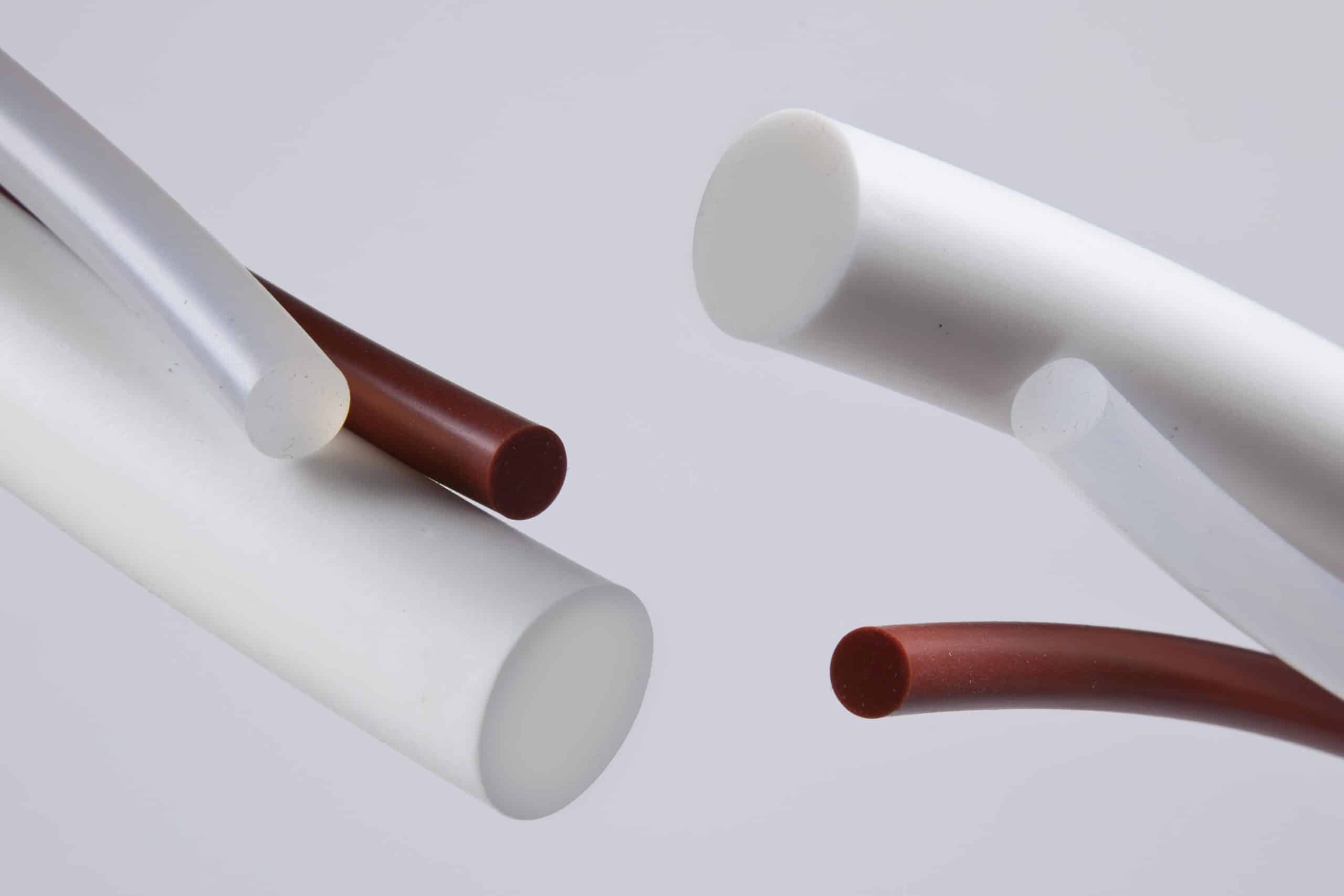
Custom Silicone O-Ring Manufacturer — UK
Viking Extrusions manufactures silicone O-rings at our factory in Worthing, West Sussex, using a route that most seal suppliers can't offer: we extrude the silicone cord ourselves, then vulcanise it into rings of exactly the diameter you specify. If you've been quoted a four-figure mould charge for a non-standard O-ring, this page is the alternative.
Moulded O-rings win on price when you need thousands of a standard BS or ISO size — the mould cost is spread across a huge volume. But the moment your O-ring is a custom diameter, a large diameter, a special material, or a small quantity, moulding becomes slow and expensive. That's where extruded-and-vulcanised O-rings take over: no mould to cut, no maximum ring size, and no penalty for ordering ten rings instead of ten thousand.
The joint is the heart of the process, and we join rings by two methods depending on the duty. RTV silicone adhesive is the quicker, more economical route — the sensible default for most static seals. Compound joining — the cord ends bonded with unvulcanised silicone and cured under heat and pressure — chemically cross-links the joint into the ring, giving the best strength and temperature performance for demanding applications. We recommend the right method for your application when we quote.
Because dies already exist for every standard cord size from Ø1mm to Ø50mm, there are no tooling charges for the vast majority of O-ring enquiries. If you need cord on the reel rather than finished rings, see our silicone rubber cord range; for rings made from non-round cross-sections — square, rectangular or fully bespoke profile sections — see our silicone joined rings.
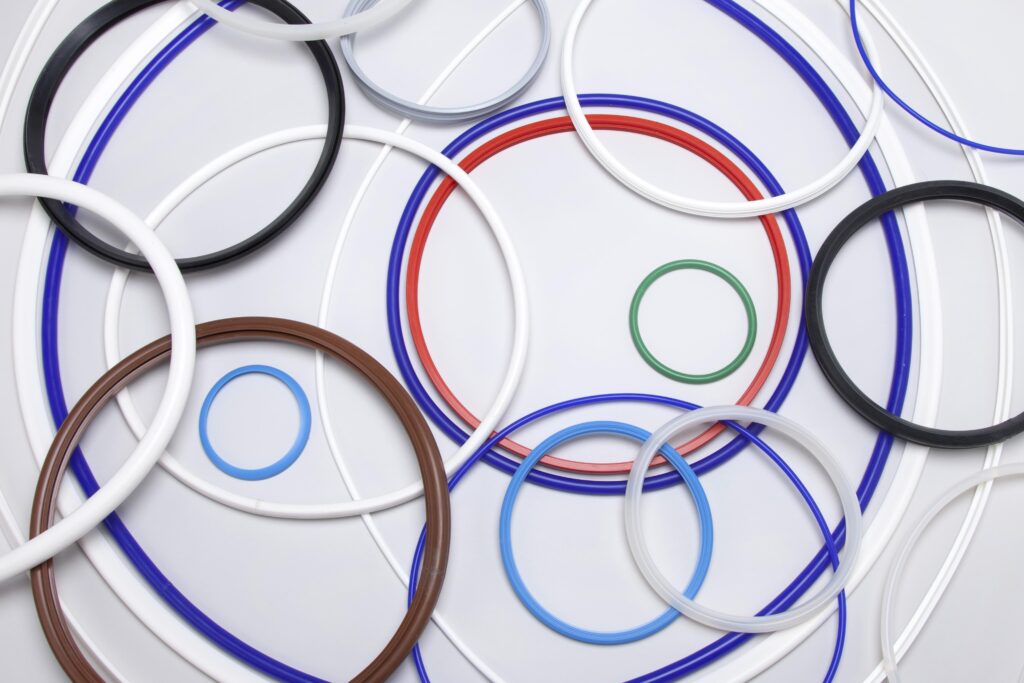
Silicone O-Ring Types We Manufacture
Every option below is available in any ring diameter — the material, cross-section and finish change; the no-size-limit rule doesn't.
- Cord Ø1mm to Ø50mm
- Shore A 20 to 80
- Translucent, black, red + custom colours
- -50°C to +200°C continuous
- FDA 21 CFR 177.2600
- EC 1935/2004 compliant
- Odourless and tasteless
- Steam-clean & autoclave resistant
- Detectable by standard in-line systems
- Food-contact compliant
- Typically supplied in blue
- HACCP-friendly specification
- Continuous service to +300°C
- Low heat ageing
- Retains elasticity at extremes
- Ideal for oven & appliance seals
- Density 150–500 kg/m³
- Low closure force sealing
- Excellent compression recovery
- Dust & weather sealing
- Square & rectangular sections
- D-sections and bespoke profiles
- See our silicone joined rings range
- Custom tooling if no die exists
Need a ring made from a profile section rather than cord — or a frame-shaped seal with vulcanised corners? That's the territory of our silicone joined rings, made with exactly the same vulcanising process.
Choosing the Right Silicone for Your O-Ring
The same ring geometry behaves very differently depending on the compound and hardness you choose. Two decisions matter most.
1. Pick the Grade
Standard VMQ silicone covers most sealing duties from -50°C to +200°C with excellent UV, ozone and weathering resistance. Step up to food-grade for anything product-contact, metal-detectable for food factories, or high-temperature grade for continuous service to +300°C. Platinum-cured silicone is available where purity and low volatiles matter, such as pharmaceutical and medical equipment. Our guide to silicone rubber grades walks through the full range and when to use each.
2. Pick the Hardness
O-ring sealing force is a trade-off. Softer cord (Shore A 20–40) conforms to imperfect surfaces and seals with less clamping load — ideal for thin lids and lightweight enclosures. Harder cord (Shore A 60–80) resists extrusion into gaps and holds up under pressure and abrasion. Most of our O-rings ship at 60 Shore A, but we extrude cord from Shore A 20 to 80, plus sponge grades when even the softest solid cord needs too much force. If you're unsure, our shore hardness guide explains how to choose — or we'll simply send samples in two or three hardnesses to try.


How to Specify a Silicone O-Ring
Four pieces of information are all we need to quote. If you only have a sample — even a worn one — send that instead and we'll measure it for you.
All silicone O-rings are manufactured to BS 3734-1 / ISO 3302-1 tolerance Class E2 as standard on the cord cross-section, with tighter tolerances available on request. Send your specification or sample to our team for a same-week quotation — contact us here.
Silicone O-Rings Across Industry
From dairy fittings to hatch seals, custom silicone O-rings solve the sealing problems that off-the-shelf sizes can't reach.
Silicone O-Ring Capabilities
The full envelope of what we can manufacture. If your requirement sits outside it, ask anyway — special cord sizes can be tooled quickly in-house.
| Property | Specification | Notes |
|---|---|---|
| Cord Diameter | Ø1mm to Ø50mm | Dies exist for standard sizes — no tooling charge |
| Ring Size | From ~100mm length (circumference), no maximum | Minimum depends on cord diameter & material |
| Temperature Range | -50°C to +200°C (standard), +300°C (HT grade) | Continuous service rating |
| Hardness (Solid) | Shore A 20 to 80 | 60 Shore A most common for O-rings |
| Density (Sponge) | 150 to 500 kg/m³ | Closed-cell sponge cord |
| Joint Method | RTV adhesive or vulcanised compound | RTV: quicker & economical · compound: strongest at temperature |
| Cross-Sections | Round, square, rectangular, D & bespoke | Non-round sections via our joined-ring service |
| Material Grades | Standard, FDA/EC 1935, metal detectable, HT, sponge | Platinum-cured options available |
| Tolerances | BS 3734-1 / ISO 3302-1 — cord to Class E2 as standard | Tighter case-by-case after engineering review |
| Colours | Translucent, white, black, red, blue, grey + custom | RAL / Pantone colour matching |
| Minimum Order | 10 metre cord equivalent | Small batches and one-off prototypes welcome |
| Lead Time | Typically 1–3 weeks | Express service available on request |