Live Lead Times: from 5 working days UK Manufactured & Worldwide Shipping 01903 205 532 [email protected]
🏭 UK Rubber Moulding Company · Est. 1991

Rubber Moulding

Custom rubber moulding manufactured in Worthing, West Sussex — compression, transfer and injection moulded components in silicone, EPDM, nitrile, neoprene, FKM and natural rubber. From one-off prototypes to production runs, with tooling quoted transparently.

3 Processes
Compression · Transfer · Injection
6 Materials
Silicone to Natural Rubber
ISO 3302-1
Class M3 Standard Tolerances
Made in UK
Worthing, West Sussex
MOULDING PROCESSES

Three Ways to Mould a Rubber Part — and How to Choose

Each process has a sweet spot. We run all three, so our recommendation is based on your part, volumes and budget — not on the one machine we happen to own.

Lowest Tooling Cost
Compression Moulding
A pre-measured blank of rubber is compressed between heated mould halves. The workhorse process for prototypes, larger parts and low-to-medium volumes.
  • Most economical tooling
  • Ideal for larger components
  • Prototype-friendly
  • All materials including silicone
Rubber compression moulding →
For Inserts & Detail
Transfer Moulding
Rubber is transferred from a pot through runners into a closed cavity — better flow control than compression, ideal for bonded metal inserts and finer detail.
  • Rubber-to-metal bonding
  • Sharper detail than compression
  • Moderate tooling cost
  • Medium volumes
Rubber transfer moulding →
High Volume Precision
Injection Moulding
Heated rubber is injected under pressure into a closed multi-cavity tool. The fastest cycle times, tightest repeatability and lowest per-part cost at volume.
  • Lowest unit cost at volume
  • Tightest repeatability
  • Minimal flash and waste
  • Multi-cavity production
Rubber injection moulding →
Choosing FactorCompressionTransferInjection
Tooling investmentLowestModerateHighest
Unit cost at volumeHigherModerateLowest
Best volumesPrototypes – mediumLow – mediumMedium – high
Metal inserts / bondingPossibleExcellentGood
Fine detail & tolerancesGoodBetterBest
Typical partsBlocks, buffers, large sealsBonded mounts, bushesGrommets, boots, precision seals

UK Rubber Moulding Manufacturers

Viking Extrusions is a UK rubber moulding company based in Worthing, West Sussex. Alongside our extrusion lines we run a full moulding shop, producing custom rubber mouldings for engineers, OEMs and maintenance teams across the UK — from a single replacement part to scheduled production.

Because we both mould and extrude, we start with your part — not our process. A constant cross-section is usually cheaper to extrude; a discrete 3D component needs moulding. Either way, tooling is designed in-house, quoted separately from unit price, and remains dedicated to your parts.

Every batch is manufactured to ISO 9001 disciplines with full material traceability, in compounds from FDA food-safe silicone to fuel-resistant FKM. If you're comparing rubber moulding companies, send the same drawing to us and let the quote do the talking.
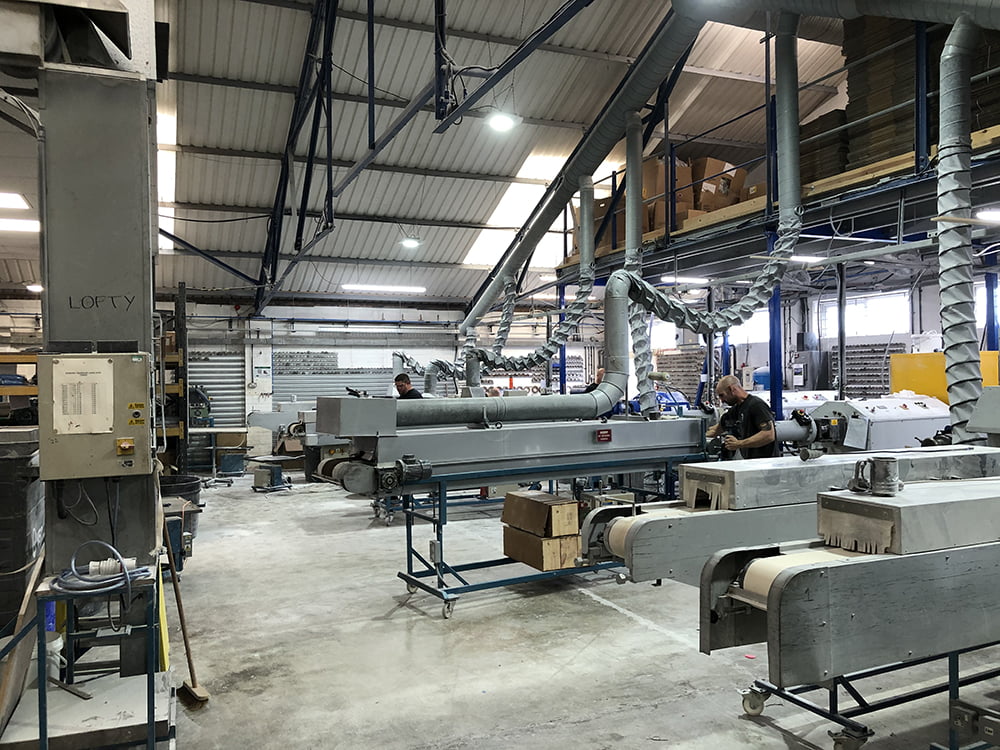
Rubber moulding and extrusion manufacturing at Viking Extrusions, Worthing
🔧
In-House Tooling
Mould tools designed & quoted transparently
📐
ISO 3302-1 Class M3
Tighter after engineering review
🍽️
FDA Grades
Food-safe silicone mouldings
🔩
Rubber-to-Metal Bonding
Inserts moulded in place
📦
Prototype to Production
No volume too small to quote
🇬🇧
UK Manufactured
All production in Worthing
FROM DRAWING TO DELIVERED PART

How Your Moulded Part Gets Made

The same four stages whether you need fifty grommets or a scheduled production contract.

1
Design & Tooling
We review your drawing, sample or sketch, recommend the process and material, and design the mould tool — accounting for cure shrinkage so the finished part hits your dimensions, not the tool's. Tooling is quoted separately and stays dedicated to your parts.
2
Compound Preparation
The rubber compound is prepared to specification — hardness, colour and any compliance requirement such as FDA food contact or flame retardancy — with batch traceability from raw material onward.
3
Moulding & Cure
The part is moulded and vulcanised under controlled temperature, pressure and time. Any bonded metal inserts are prepared and moulded in place. Post-cure follows where the material or compliance grade requires it.
4
Finishing & Inspection
Parts are deflashed, inspected against the drawing to the agreed ISO 3302-1 class, and packed. First-article inspection reports are available for new tooling, and every batch traces back to its compound lot.
💬
What We Need From You
A drawing (PDF, DXF or STEP), a physical sample — even a worn one — or a sketch with dimensions. Plus the operating environment: temperature, media, outdoors or food contact, and your expected annual volumes.
Typical Timescales
Tooling design and manufacture typically runs 3–6 weeks depending on complexity; production follows in days once the tool is approved. Prototype routes — including 3D-printed mould tooling for silicone — can compress this dramatically.
CAPABILITIES

Rubber Moulding Capabilities

PropertySpecificationNotes
ProcessesCompression, transfer, injectionRecommended per part & volume
MaterialsSilicone, EPDM, NBR, CR (neoprene), FKM, NRSpeciality compounds on request
HardnessShore A 30 to 90 (material dependent)Softer silicones available
TolerancesISO 3302-1 Class M3 standardSee our tolerances guide
Rubber-to-metal bondingInserts moulded in placeBrass, steel, aluminium
Compliance optionsFDA 177.2600, EC 1935/2004, WRASGrade dependent
ColourAny — RAL / Pantone matchedBlack standard for organics
VolumesPrototypes to scheduled productionTooling quoted separately
FREQUENTLY ASKED QUESTIONS

Rubber Moulding FAQ

What is rubber moulding?
Rubber moulding is the process of shaping uncured rubber compound inside a heated steel mould tool, where pressure and temperature cure (vulcanise) it into a finished component. The three main processes are compression moulding, transfer moulding and injection moulding — each suited to different part geometries, volumes and materials. Viking Extrusions offers all three from our factory in Worthing, West Sussex.
Which moulding process is right for my part?
As a rule of thumb: compression moulding suits simpler shapes, larger parts and lower volumes with the lowest tooling cost; transfer moulding suits parts with metal inserts or more intricate detail; injection moulding suits high volumes and tight tolerances, with the highest tooling investment but the lowest per-part cost. Send us your drawing and volumes and we will recommend the most economical route.
What materials can you mould?
We mould all the main engineering elastomers: silicone (including FDA food-safe and high-temperature grades), EPDM, nitrile (NBR), neoprene, FKM/Viton and natural rubber. Material selection depends on temperature, chemical exposure, weathering and regulatory requirements — our technical team will recommend the right compound for your application.
How much does mould tooling cost?
Tooling cost depends on the process, part size and cavity count. Compression mould tools are the most economical and suit prototypes and lower volumes; multi-cavity injection tools cost more but repay the investment on long production runs through faster cycles and lower part prices. We quote tooling and unit price separately so you can see the trade-off clearly, and tooling remains dedicated to your parts.
Should my part be moulded or extruded?
If your component has a constant cross-section — seals, gaskets strips, tubing, profiles — extrusion is usually more economical, with lower tooling costs and no length limit. If it is a discrete three-dimensional shape — a grommet, boot, bung, buffer, mount or complex seal — it needs to be moulded. Viking Extrusions does both in-house, so our recommendation is based on what suits your part, not what we happen to offer.
What tolerances can moulded rubber parts achieve?
Moulded rubber dimensions are classified by ISO 3302-1 tolerance classes M1 (precision) to M4 (coarse). Class M3 is our standard for moulded components, with tighter classes available on a case-by-case basis after engineering review. As with extrusions, only tighten the dimensions that matter functionally — tighter classes increase tooling and inspection cost.
Get a Rubber Moulding Quote

Send us your drawing, sample or application details — we'll recommend the right process and material, and quote tooling and unit price transparently.

Viking Extrusions Ltd · Rubber Moulding Manufacturers · Est. 1991 · Worthing, West Sussex, UK